What the maker puts in writing
- “This cutting board is made of polypropylene plastic. The poly material is non absorbent, nonporous, and will not harbor stains. It is gentle on knives, keeping their blades from getting dull quicker”
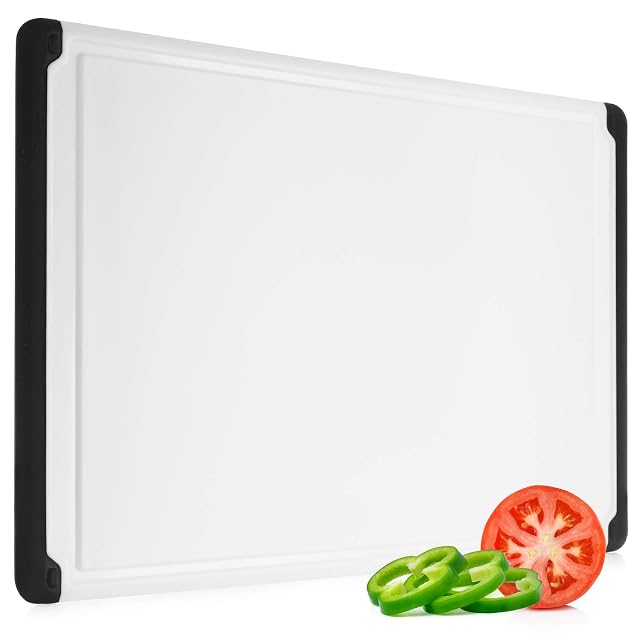
- “This cutting board is reversible for double the cutting surface and features a hand hole for added control and stability”
- “Ideal for Cutting, Slicing and Chopping Meats, Poultry, Fish and Vegetables”
- “MEASUREMENTS: 11 inch long by 14 inch wide by 0.25 inches thick”
- “Farberware is the Top-Selling National Brand for Cutting Boards in the U.S. (Source: The NPD Group, Inc./Retail Tracking Service. 52 weeks ending April 2016)”
- “made of BPA-free, polypropylene (poly)… will not harbor odors, stains or harmful bacteria”
Eleven by fourteen inches for six dollars
Which is the comparison that frames this whole shelf.
Belwares sells one 18 × 12 in board for $20.99 — with rubber feet and a deep juice groove. This is 11 × 14 in for $6.33 with neither.
So Belwares gives about 216 square inches against this board’s 154, and adds two features. For more than three times the price.
For a lot of kitchens, two of these at $12.66 is the better answer.
A cited source, nine years stale
Top-Selling National Brand for Cutting Boards in the U.S. (Source: The NPD Group, Inc./Retail Tracking Service. 52 weeks ending April 2016)
Citing a research house and a measurement window is more than any other listing here manages. The nearest is GORILLA GRIP’s “3rd Party Tested for durability”, which names no body and no standard.
But April 2016 is nine years ago. Read it as evidence that somebody checked, once, a decade back.
Polypropylene, named
Four of twelve boards here name their material: both Farberwares, HOMWE and Fotouzy. Eight say “plastic” or “BPA-free plastic”.
Polypropylene is the right material. Genuinely non-porous, so it takes up no juice. Tough enough to take a knife without shattering or shedding chips. And it handles dishwasher heat better than polyethylene.
Note what “BPA-free” is worth on it: BPA is a bisphenol used in polycarbonate, not in polypropylene. True, and uninformative.
A quarter of an inch
Thicker than Farberware’s own 8 × 10 board (5 mm (0.20 in)) by 27 per cent, and still at the thin end here:
- 5 mm (0.20 in) — Farberware 8 × 10 · 6.35 mm (0.25 in) — this
- 7.6 mm (0.30 in) — Freshware · 8.9 mm (0.35 in) — Viretang · 9.4 mm (0.37 in) — GORILLA GRIP
- 9.9 mm (0.39 in) — Empune
Thickness resists flex when you lean on a corner, and warping in a hot dishwasher — polypropylene softens as it heats, and a thin sheet cooling unevenly can take a permanent bow. Fotouzy is the only listing here to publish a wash temperature limit (<90 ℃), which is the right thing to state about thin PP.
Reversible, and genuinely so
Flat on both faces, with a hand hole.
Worth stating because three listings here claim rubber feet and reversibility: Belwares, Viretang and ROTTOGOON. A board with feet on one side cannot lie flat on the other. The coherent answers are a rubber border (GORILLA GRIP) or edge handles (Empune).
What it does not have
No juice groove, on a board sold for meats, poultry, fish. Six boards on this shelf have one, and on a carved roast or a sliced tomato it is the difference between a clean worktop and a wiped one.
No feet, no border. Four hundred and ninety-nine grams slides on a wet surface. No warranty — only Empune and Fotouzy publish one.
Availability
On sale at around $6 on the American Amazon store at the time of checking.
Prices and availability are what Keepa reported on the date this page was updated; both move.
Prices quoted in this text were read on 4 October 2026. The live price is at the top of the page.