What the maker puts in writing
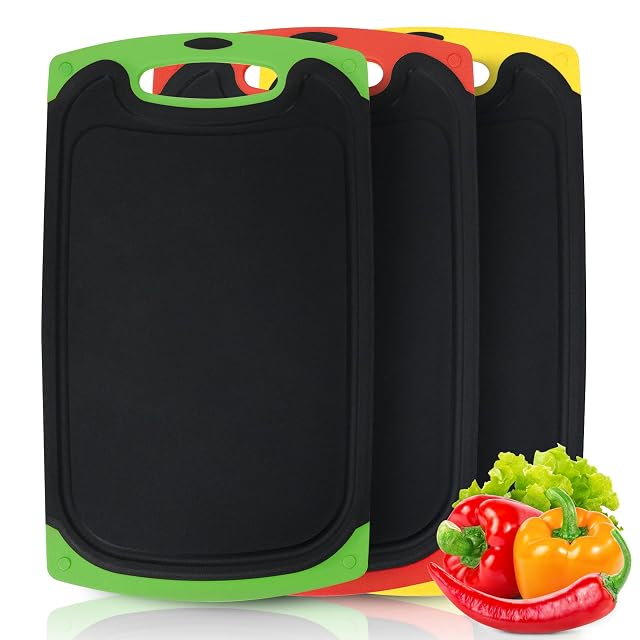
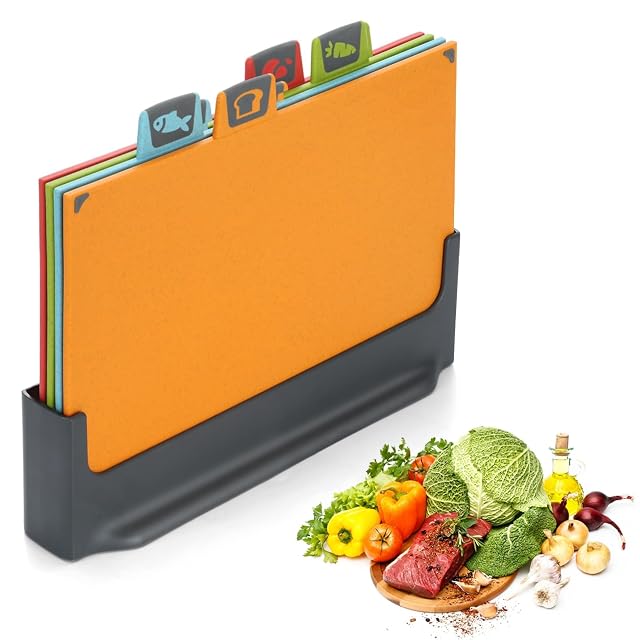
- “Our cutting board set has 4 different colors help avoid mixing food flavors caused by mixing cutting board while cutting food. Red for meat, yellow for fruit, blue for fish, green for vegetables”
- “each of the flexible cutting mats has a grid-textured bottom, could be put on most surface. For wet or very slippery surfaces, just place a dampened paper towel underneath”
- “Lightweight, bendable and durable. These cutting boards are easy to store and curl to a certain angle, which is helpful to pour the chopped food for cooking or other use”
- “made of BPA free food grade material, produces fewer scratches. They are dishwasher safe(<90℃) and handwash easily”
The only color-coded set on this shelf
Red for meat. Yellow for fruit. Blue for fish. Green for vegetables. With food icons printed on the mats.
That is close to the convention commercial kitchens are required to follow, and the reason it works is that it needs no memory. You do not have to recall which face of a board the raw chicken was on.
Every other listing here handles cross-contamination by reversibility — one side for raw, one for bread — or by size — a small board for fruit, a large for meat. Both depend on you remembering. Printed icons do not.
Bending, which solves a real daily problem
“curl to a certain angle, which is helpful to pour the chopped food”
Having diced an onion, you have to get it into the pan. On a rigid board you push it toward the edge with the knife and lose a third over the side.
A mat you can bend into a chute delivers all of it.
OXO on this shelf answers the same problem on a rigid board, with molded “easy-pour corners”. Those are the only two listings here that address it at all.
Ninety degrees, and nobody else says it
Dishwasher safe (<90℃).
The only wash temperature limit on this shelf, and exactly the right thing to publish about thin plastic.
Polypropylene starts losing stiffness well below its melting point, and a 4 mm (0.16 in) sheet cooling against a rack after a hot cycle can take a permanent bow. A stated limit tells you to use a normal cycle rather than the sanitizing one.
Eight boards here claim dishwasher safety with no limit at all — including Farberware’s 5 mm (0.20 in) board. The thick ones (Empune 9.9 mm (0.39 in), GORILLA GRIP 9.4) have the margin to get away with it.
Two dollars fifty a mat
The lowest price per piece on this shelf:
- $2.50 — this, four mats
- $4.66 — Freshware and Viretang, three boards each
- $5.66 — ROTTOGOON · $7.30 — GORILLA GRIP · $8.00 — HOMWE
- $8.75 — Empune, four boards · $13.98 — OXO, two
- $20.99 — Belwares, one board
The grid back, and the honest extra
A grid-textured bottom, could be put on most surface. Then the admission: for wet or very slippery surfaces, just place a dampened paper towel underneath.
Which tells you the grid alone is not enough on a wet worktop. It is the only listing on this shelf to offer a workaround rather than simply claim non-slip.
What a mat cannot do
No juice groove — impossible on something that bends.
No support. At 4 mm there is nothing under the knife, so jointing a chicken or splitting a squash on one of these is unpleasant and unsafe. Prep on a mat; butcher on a thick board.
No material named, where four boards here say polypropylene. No individual mat dimensions. No warranty — Empune and Fotouzy’s own rigid board both publish one.
Availability
On sale at around $10 on the American Amazon store at the time of checking.
Prices and availability are what Keepa reported on the date this page was updated; both move.
Prices quoted in this text were read on 4 October 2026. The live price is at the top of the page.
The questions that come in
Is color coding actually useful at home?
It is the most reliable way to keep raw meat off the surface your salad touches, and this is the only listing on this shelf to use it. Fotouzy publishes the assignment and prints food icons on the mats: "Red for meat, yellow for fruit, blue for fish, green for vegetables". That is close to the convention commercial kitchens are required to use, and the reason it works is that it needs no memory — you do not have to recall which face of a board the chicken was on. Every other listing here handles cross-contamination either by reversibility ("one side for raw, the other for bread") or by size ("a small board for fruit, a large for meat"), both of which depend on you remembering. Printed icons do not.
What does flexibility actually buy?
Pouring, and Fotouzy names it: the mats "curl to a certain angle, which is helpful to pour the chopped food". That is a real daily annoyance a rigid board cannot solve. Having diced an onion, you have to get it into the pan — and on a flat board you push it toward the edge with a knife and lose a third over the side. A mat you can bend into a chute delivers all of it. OXO on this shelf answers the same problem differently, with "easy-pour corners" molded into a rigid board. What flexibility costs is support: at 4 mm (0.16 in) these offer nothing under a cleaver, and jointing a chicken on one is unpleasant. Use a mat for prep and a thick board for butchery.
Why does the 90 °C (194 °F) limit matter?
Because thin polypropylene softens, and this is the only listing on this shelf honest enough to put a number on it. Fotouzy publishes "dishwasher safe (<90℃)". Polypropylene begins to lose stiffness well below its melting point, and a 4 mm (0.16 in) sheet coming out of a hot cycle and cooling against a rack can take a permanent bow or curl. A temperature limit tells you to use a lower cycle and not the sanitizing one. Eight boards on this shelf claim dishwasher safety with no limit at all, and several are thin: Farberware’s 8 × 10 is 5 mm (0.20 in), its large board 6.35. The thick ones — Empune at 9.9 mm (0.39 in), GORILLA GRIP at 9.4 — have far more margin.