Skip to content

Steak knives: serrated or straight, and what that costs

Steak knives split cleanly into two kinds. A serrated blade saws through anything, survives a dishwasher and a plate rim, and cannot be sharpened meaningfully. A straight-ground one cuts more cleanly, needs looking after, and can be brought back forever. The choice is about how the knives will be treated, not how they cut.

Two kinds of knife, five sets.

Serrated, and stated dishwasher safe

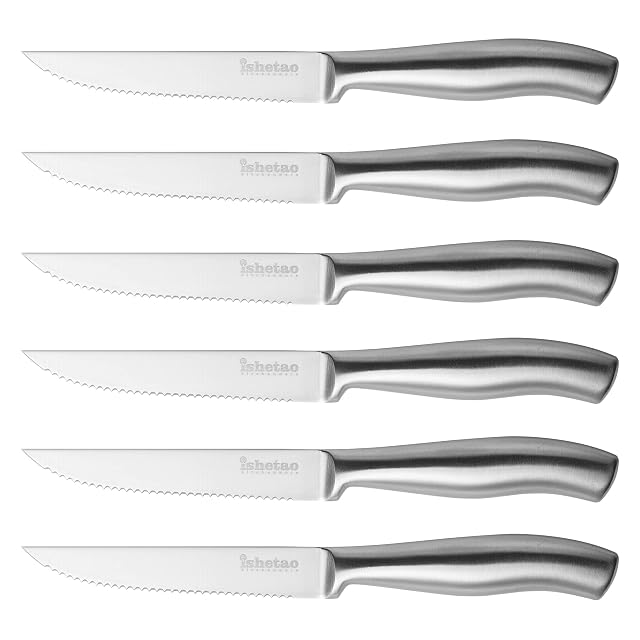
The Ishetao six at 12 cm (4.7 in), high-carbon stainless, serrated, stated dishwasher safe. The cheapest set here, and the one that asks least of you.

Straight, forged, triple riveted

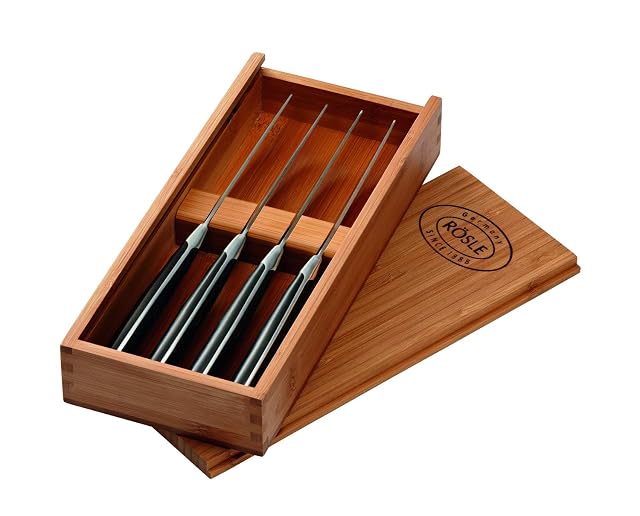
The Rösle four in forged blade steel with triple-riveted plastic handles and a sharp ground edge. Forged rather than stamped, and a triple rivet is what stops a handle loosening after years of washing.

The design one

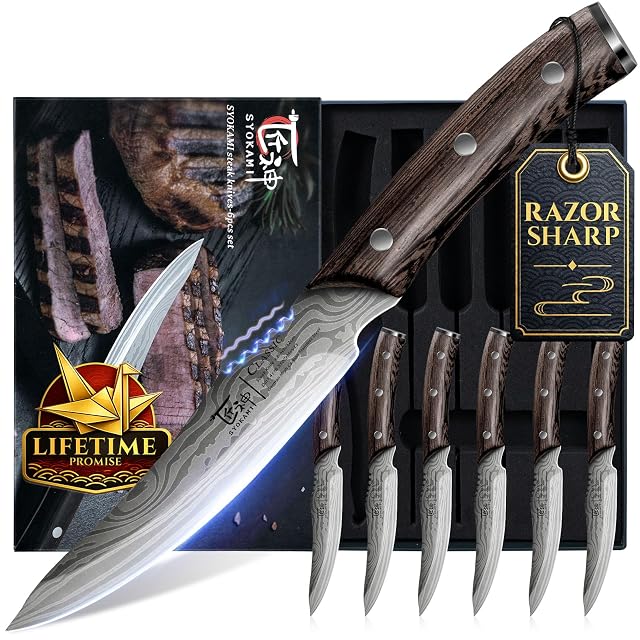
The Syokami six in Japanese high-carbon stainless with a Damascus-look finish and a raised blade. Note the wording: Damascus-look is a finish, not a forged lamination, and stating it plainly is more honest than most listings in this hub.

The table one

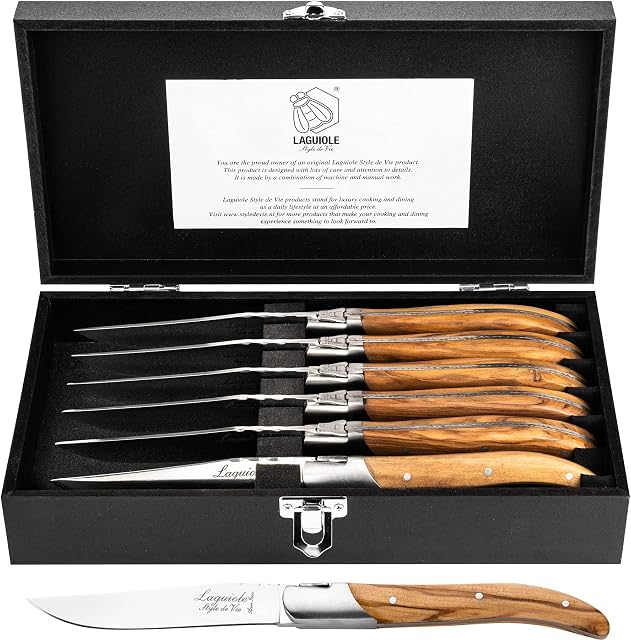
The Laguiole-style de Vie six with olive wood handles, straight ground edges and a wooden presentation case. Olive wood means hand washing, always.

The specified one

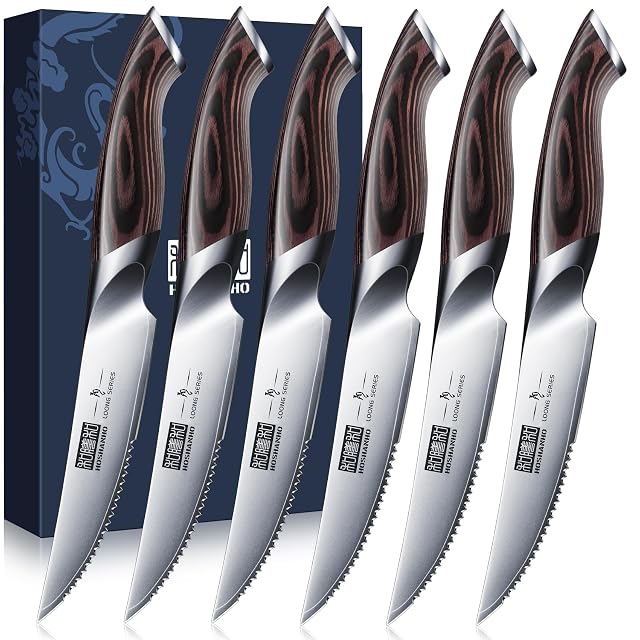
The Hoshanho six in 10Cr15CoMoV carbon steel with a stated semi-serrated 15° edge and pakkawood handles. Fifteen degrees per side is keen for a table knife — which means it will cut beautifully and should never touch the plate rim.

The rule that outlasts the set

Cut on the meat, not through to the plate. Every knife here dulls on porcelain and none of them dulls on beef.

Which pan does your cooking want?

You want them to stay sharp untouched
Serrated blades, which never need sharpening and never quite cut cleanly.
You want a clean cut
Straight edges, which need occasional sharpening.
They will go in the dishwasher
That decides the handle material more than anything else.
You entertain rarely
Four is usually plenty, and a set of twelve is optimism.

Picking by what you cook

At the table

The only job, and one where appearance genuinely counts alongside cutting.

Cutting cleanly

Where a straight edge slices rather than tears, which shows on a good piece of meat.

Zero maintenance

Where serrated blades keep working for years without any attention at all.

Everyday use

Where steak knives quietly become the table knives, which changes what matters.

What makes the difference in use

Serrated or straight
The whole decision. Serrated never needs sharpening and tears slightly; straight cuts cleanly and needs maintaining.
Handle material
Wood looks better and cannot be dishwashed. Composite and steel handles can.
How many
Four covers most households. Sets of twelve are bought for occasions that rarely happen.
Balance
Table knives are held lightly, so a knife that feels top-heavy is unpleasant to use.
Storage
Loose steak knives in a drawer damage each other’s edges. A roll or a box matters more than expected.

Which figure for which dish

Your priorityThe bladeThe consequence
No maintenanceSerratedSlightly tears the cut
Clean cuttingStraightNeeds sharpening
DishwasherComposite handleWood will not survive
PracticalityFour knivesTwelve is optimism

Where it usually goes wrong

Buying twelve
Most households host four to six people. The other six knives take drawer space and never get used.
Putting wooden handles in the dishwasher
They split and loosen. If dishwashing is the household norm, buy composite or steel.
Storing them loose in a drawer
Edges knock together and dull. A simple box or roll is what keeps them usable.
Expecting serrated blades to cut like straight ones
They tear slightly, which is the price of never needing sharpening. That trade is the whole choice.

By the cook you are

The practical household
Serrated blades with composite handles that go in the dishwasher and never need attention.
The particular cook
Straight edges, kept sharp, because a clean cut shows on good meat.
The occasional host
Four knives, stored properly, rather than a set that fills a drawer.

Care, seasoning and how long it lasts

Steak knives spend their lives being washed and stored rather than used, and that is where they degrade. Handles loosen in dishwashers, blades dull against each other in drawers, and serrated edges eventually wear beyond usefulness with no way back.

  • Hand wash wooden handles and dry them immediately.
  • Store in a box or roll rather than loose in a drawer.
  • Hone straight-edged blades occasionally to keep them cutting.
  • Accept that worn serrated blades are replaced rather than sharpened.

Safety

Sharp knives at a table need thought.

  • Place them with the edge facing the plate.
  • Take particular care with children at the table.
  • Never leave them submerged in a bowl of washing water.
  • Keep them sharp; a blunt knife at the table is pushed harder and slips.

Our choices, and the reasons

  1. isheTao 6-piece serrated set

    Set of 6 · 12 cm (4.7 in) serrated blades · high-carbon stainless · dishwasher safe stated

    Six 12 cm (4.7 in) serrated steak knives in high-carbon stainless, stated dishwasher safe — the practical choice for a table where knives get washed with everything else.

    Best for: A household table, where convenience beats refinement.

    7.5/10

    ≈ $24

  2. RÖSLE 4-piece forged set

    Set of 4 · forged blade steel · triple-riveted plastic handles · sharp ground edge

    Four forged steak knives with triple-riveted handles, from a German kitchenware maker — the construction that keeps a handle attached over decades.

    Best for: A table of four, and someone who prefers a clean cut to no maintenance.

    7.5/10

    ≈ $75

  3. SYOKAMI 6-piece Japanese-style set

    Set of 6 · Japanese high-carbon stainless · Damascus-look finish · raised blade design · textured grip

    Six Japanese-style steak knives whose blades are shaped so the edge does not rest on the table between courses — a hygiene detail nobody else here addresses.

    Best for: A table where knives are set down between mouthfuls, which is every table.

    8.1/10

  4. HOSHANHO 6-piece 10Cr15CoMoV set

    Set of 6 · 10Cr15CoMoV carbon steel · semi-serrated 15° edge stated · pakkawood handles

    The top of this hub: six steak knives in named 10Cr15CoMoV steel with a semi-serrated edge ground at a stated 15°, on pakkawood handles.

    Best for: Someone who wants a clean cut without committing to sharpening six knives.

    8.1/10

    ≈ $180

The questions that come in

Can a serrated steak knife be sharpened?

Not usefully with ordinary equipment. The scallops need a tapered rod worked one at a time, and most people replace instead. That is the trade for never needing to.

Do steak knives go in the dishwasher?

Some listings state dishwasher safety and some do not. Wooden handles should not, whatever the blade says — the Laguiole-style set here has olive wood handles and the Hoshanho has pakkawood.

Why does the plate matter?

A porcelain plate is harder than knife steel. Every stroke that reaches the plate dulls the edge, which is the real reason table knives go blunt — not the meat.

Serrated or straight edge?

Serrated never needs sharpening and tears slightly. Straight cuts cleanly and needs occasional maintenance. That trade is the whole decision.

How many should I buy?

Four suits most households. Sets of twelve are bought for gatherings that happen far less often than people imagine.

Can they go in the dishwasher?

Composite and steel handles usually can; wooden ones split and loosen. Choose the handle to match the household’s habits.

How should I store them?

In a box or roll rather than loose in a drawer, where edges knock together and dull each other.

Can serrated blades be sharpened?

Not practically at home. That is the trade: no maintenance, and replacement when they eventually wear out.

Do they need to match the kitchen knives?

Not at all. Steak knives are a table item, and appearance is a legitimate part of the choice.
Each pan, and the cooking it rewards

isheTao SK_0890 · $24

Good for: A household table, where convenience beats refinement.

What it does best: Six knives, which covers a table of six without borrowing

What it does badly: Serrated edges tear the surface of meat where a straight edge slices

Read the full review →

RÖSLE 25147 · $75

Good for: A table of four, and someone who prefers a clean cut to no maintenance.

What it does best: Forged rather than stamped, which is unusual on steak knives

What it does badly: Four rather than six — a table of six needs two sets

Read the full review →

SYOKAMI Steak Knives Set of 6

Good for: A table where knives are set down between mouthfuls, which is every table.

What it does best: The raised blade keeps the edge off the tablecloth, which is a genuine hygiene point

What it does badly: "Damascus-look" is explicitly an appearance, not a construction

Read the full review →

Laguiole Style de Vie LuxSteakOlijf · $80

Good for: A table, a gift, and a household that washes up by hand.

What it does best: Olive wood handles, each one different, which is the point of them

What it does badly: Wooden handles must not go in the dishwasher, and the listing does not say so

Read the full review →

HOSHANHO HSHEST-2023-021 · $180

Good for: Someone who wants a clean cut without committing to sharpening six knives.

What it does best: Names the steel and publishes an edge angle — 15° — which no other set here does

What it does badly: The most expensive set in this hub

Read the full review →

Short answer first

What is behind this list

The pans here are drawn from the catalog of this site. Specifications come from the maker and from the Amazon product page; prices are what Keepa recorded on the date below, and both move. Order is set by declared specifications, by stated strengths against stated limits, and by price. Nothing here has been cooked with by us, and no claim to the contrary is made.

Last checked on

Prices quoted in these summaries are dated readings. The live price is shown next to each product.

The tool we use ourselves

Chosen your tool? Now buy it at the right price.

Cookware sets, knife blocks and cast iron swing by thirty dollars or more across the year, and the biggest "discounts" often land at prices the same model sold for six weeks earlier. UniverTrack tracks the real price history across retailers, spots fake reductions, and alerts you when it is genuinely the moment to buy.

Real price historyBuy-now alertsAI buying assistant
Try free for 14 days →
No commitment · Cancel in one click · 5 languages