An eleven-piece set usually means five pots and six lids. That is not dishonest, and it is not what most people count. The sets worth buying are the ones that publish every size, so you can check them against what you already own — and the ones whose extras change how a pot is used rather than padding the number.
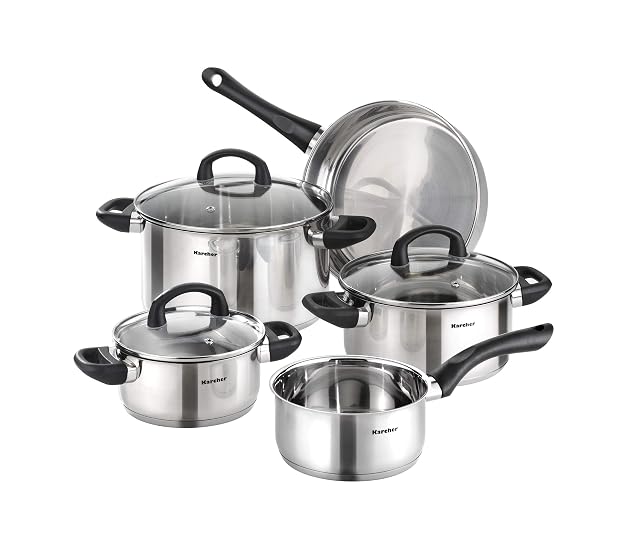
The Karcher five-piece: a 16 cm (6.3 in) saucepan, 16, 20 and 24 cm (9.4 in) pots with glass lids, and a 24 cm (9.4 in) sauté pan. That list is what lets you check for duplication before buying.
The one with straining lids throughout
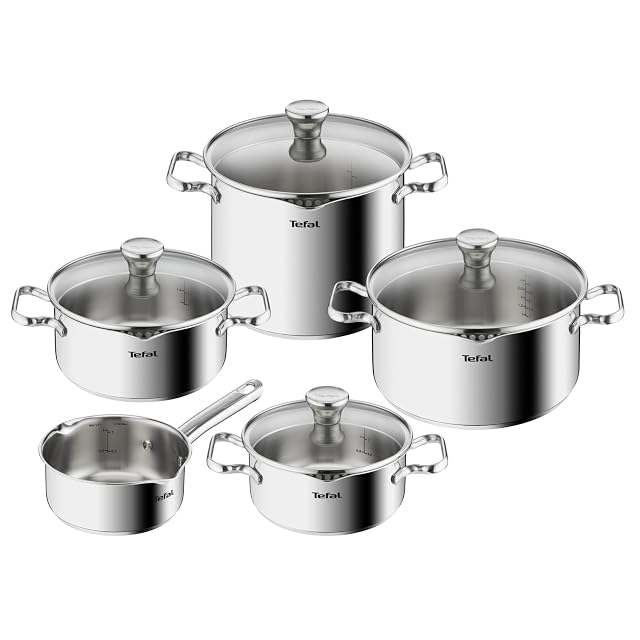
The Tefal nine-piece, with straining lids and pouring spouts, a thick bonded induction base and oven safety. Straining lids across a whole set removes the colander from most weeknight cooking.
The one with the most vessels
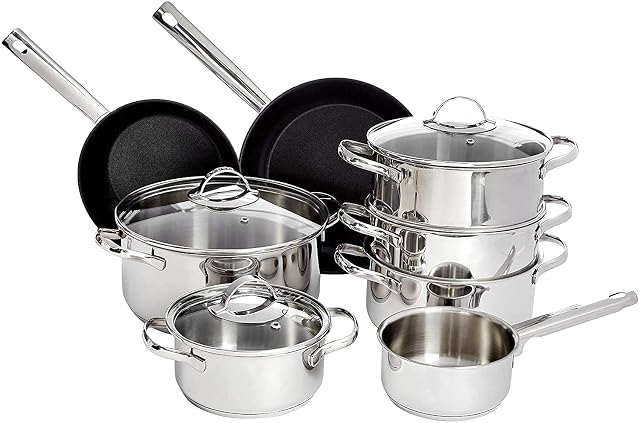
The Amazon Basics eleven-piece, with 20 and 24 cm (9.4 in) frying pans, pots with glass lids, an aluminum-core base and riveted handles. Two frying pans in a set is unusual and genuinely useful.
The one with the cleverest lids
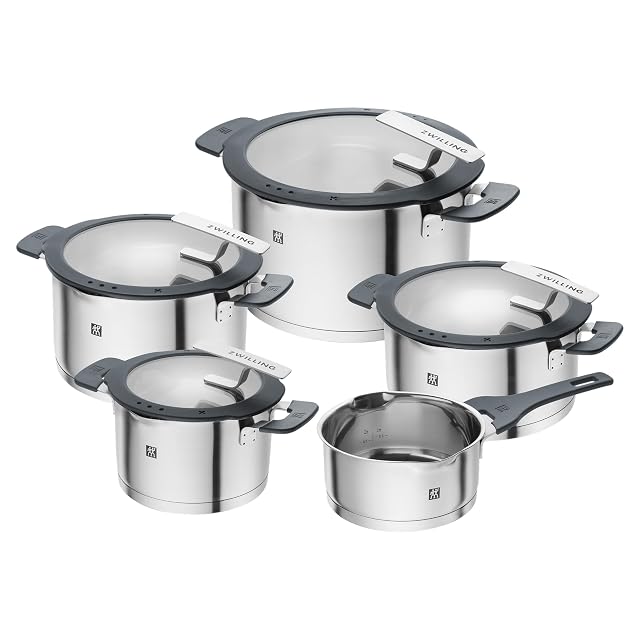
The Zwilling five-piece: two strainer sizes in the lid, a lid holder on the pot itself and silicone stay-cool handles. Two strainer sizes drain pasta and rinse rice; the lid holder means the wet lid does not go on the worktop.
The one with thermometers
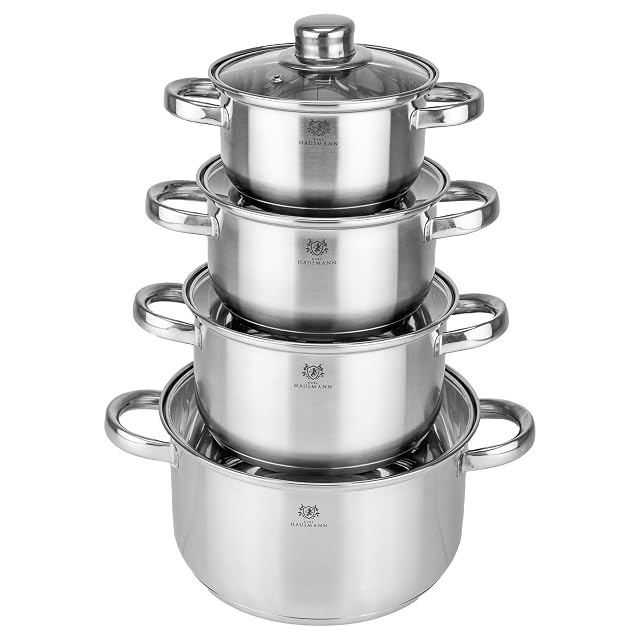
The Karl Hausmann four pots and four glass lids at 1.3, 1.9 and 2.6 liters and up, with thermometers in the lid knobs. Published capacities and a temperature reading, at the cheapest price in this hub.
The honest recommendation
If you are starting from nothing, a set is a reasonable way to get pots. If you already own three, buy the one pot you are missing instead.
Which pan does your cooking want?
You are equipping from nothing
A set is convenient, and it will still contain pieces you never use.
You already own a pan you like
Buying individually around it is almost always better value.
Storage is limited
A set is a storage commitment as much as a purchase.
The set includes lids in the count
Read the piece count carefully, because it is often flattered.
Picking by what you cook
First kitchens
Where a set genuinely simplifies a decision that would otherwise take a week.
Replacing everything at once
Where a move to induction or a house move forces a wholesale change.
Matching appearance
Where the appeal is aesthetic, which is a legitimate reason as long as it is the real one.
Gradual building
Where individual purchases beat sets, and where most experienced cooks end up.
What makes the difference in use
How the pieces are counted
Lids, and sometimes utensils, often count as pieces. A twelve-piece set may hold six pans.
Which pieces you will use
There is usually one pan you use daily and three that stay in the cupboard. Judge the set on the former.
Consistency of quality
Sets are built to a price. Something in there is thinner than you would have chosen individually.
Hob compatibility
Check the whole set, not just the pan in the photograph, particularly for induction.
Storage space
A set arrives all at once and needs somewhere to live from that day forward.
Which figure for which dish
The situation
Set or individual
Why
Empty kitchen
A small set can work
Simplifies one big decision
Already have favorites
Individual
Build around what works
Limited cupboards
Individual
A set is a storage commitment
Any
Read the piece count
Lids are often counted
Where it usually goes wrong
Judging a set by its piece count
Lids and sometimes utensils inflate the number. Count the actual pans before comparing anything.
Buying a large set for a small kitchen
It arrives all at once and has to live somewhere. Storage is part of the purchase.
Assuming the whole set suits your hob
Compatibility can vary within a range. Check every piece, not the headline one.
Buying a set to replace one worn pan
You end up with duplicates of things that were fine. Replace the piece that failed.
By the cook you are
The first kitchen
A small set is defensible, because it settles a decision quickly and cheaply.
The established cook
Buys individually, around the pieces already proven in daily use.
The small kitchen
Should count cupboard space before piece count.
Care, seasoning and how long it lasts
Sets fail unevenly, which is their real weakness: the pan you use daily wears out while four others remain untouched. That leaves you replacing individually anyway, and often unable to match what you had.
Expect to replace the most-used piece long before the rest.
Check whether individual replacements are available in the range.
Store with liners between stacked pans to prevent scratching.
Follow the same care rules across the set; materials may differ between pieces.
Safety
Mixed materials mean mixed limits.
Check the oven temperature limit for each piece; it may vary within a set.
Note which handles are ovenproof and which are not.
Follow the maker’s heat guidance for any coated pieces.
9 pieces · straining lids and pouring spouts · thick bonded induction base · oven safe
Nine pieces with straining lids and pouring spouts on the pots, and a thick bonded induction base the maker states is designed to stop the cookware distorting over time.
Best for: Households that cook pasta and rice often and want to stop reaching for a colander.
5 pieces · two strainer sizes in the lid · lid holder on the pot · silicone stay-cool handles · sandwich base with aluminum core
The most expensive set here, and the one with the most thought in its lids: two strainer sizes built in, and a holder that hangs the lid on the pot rim instead of on the worktop.
Best for: A small kitchen where every piece has to be worth its shelf space.
4 pots + 4 glass lids · 1.3 / 1.9 / 2.6 L and up · thermometers in the lid knobs · induction
Four stainless pots with four tempered glass lids, and a thermometer built into each lid knob — the only set here that publishes both total and usable volume for every piece.
Best for: A first set for a kitchen with nothing in it.
Almost always. An eleven-piece set is typically five or six vessels and their lids. Read the size list rather than the headline number.
Is a set cheaper than buying separately?
Per piece, usually. In total, often not — because a set includes sizes you would not have chosen. Five pieces you picked beat nine you were given.
What actually improves a set?
Features on the lid. Straining holes, a pouring spout, a lid holder on the pot, a thermometer in the knob — those change how often you use the pot. Extra pans do not.
Are cookware sets worth it?
For an empty kitchen a small set is defensible. Beyond that, buying individually around pieces you already use is usually better value.
How should I read the piece count?
Carefully. Lids and sometimes utensils are counted, so a twelve-piece set may contain six actual pans.
Will the whole set work on induction?
Not necessarily. Compatibility can vary within a range, so check every piece rather than the one in the photograph.
What happens when one pan wears out?
You replace it individually, which is what makes sets less economical than they look. Check first whether single replacements are sold.
Is a set better value?
It looks it, and part of that saving is in pieces you will not use. Judge it on the two or three you actually will.
What if I only need to replace one pan?
Replace that pan. Buying a whole set to solve one failure leaves you with duplicates and a storage problem.
Lids, handles and spares from the same aisle, at the price we read. Confirm they match the pan you choose before ordering: it turns on the diameter and the part number, which the product page gives.
AOTHOD 446 °F Set · Silicone utensils — Food-grade silicone cooking utensil set rated to 446 °F with stainless steel reinforcement, a thickened soft silicone head for non-stick pans and a seamless one-piece design, dishwasher safe · $20
BESTZMWK 33-Piece 304 Stainless · Silicone utensils — 33-piece utensil set with thick top-grade 304 stainless steel handles and durable silicone heads, stated free of any plastic and of BPA, dishwasher safe with hanging holes · $40
The pans here are drawn from the catalog of this site. Specifications come from the maker and from the Amazon product page; prices are what Keepa recorded on the date below, and both move. Order is set by declared specifications, by stated strengths against stated limits, and by price. Nothing here has been cooked with by us, and no claim to the contrary is made.
Last checked on
Prices quoted in these summaries are dated readings. The live price is shown next to each product.
The tool we use ourselves
Chosen your tool? Now buy it at the right price.
Cookware sets, knife blocks and cast iron swing by thirty dollars or more across the year, and the biggest "discounts" often land at prices the same model sold for six weeks
earlier.
UniverTrack tracks the real price history across retailers, spots fake
reductions, and alerts you when it is genuinely the moment to buy.
Real price historyBuy-now alertsAI buying assistant