Mandolines and graters: the tools that cause the cuts
A knife tells you it is near your finger. A mandoline does not: it takes a slice at a constant depth whether that slice is potato or thumb, and it does it at the end of the vegetable, when the piece is small and the hand is close. The tools below are good ones. The habits below matter more than which you buy.
Five tools, and two habits that matter more than all five.
The habit that prevents most of it
Use the guard from the first slice. Every mandoline injury happens on the last piece, when the vegetable is short and the fingers are close, and the guard is only useful if it is already in your hand.
The habit that prevents the rest
Wear a cut-resistant glove on the holding hand. This site lists five pairs, including one at a published EN 388 level E and one stated food safe for kitchen use.
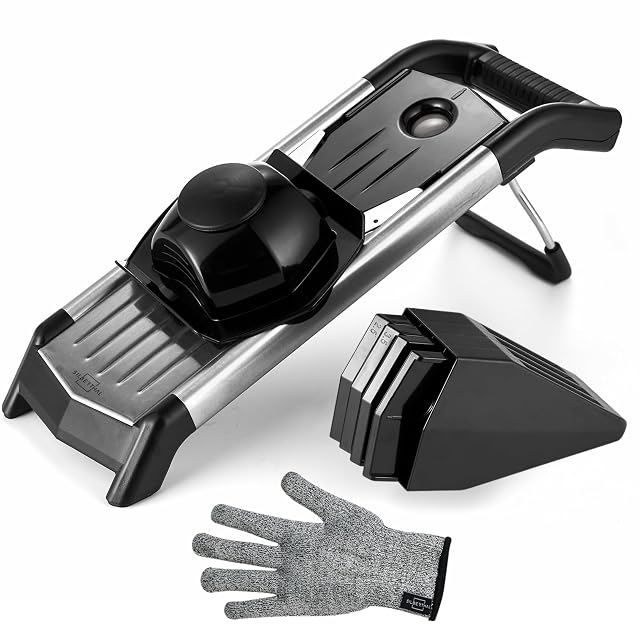
The mandoline with a guard included
The Silberthal, stainless V-blade with interchangeable inserts, a folding foot and a hand guard included. A guard sold separately is a guard nobody buys.
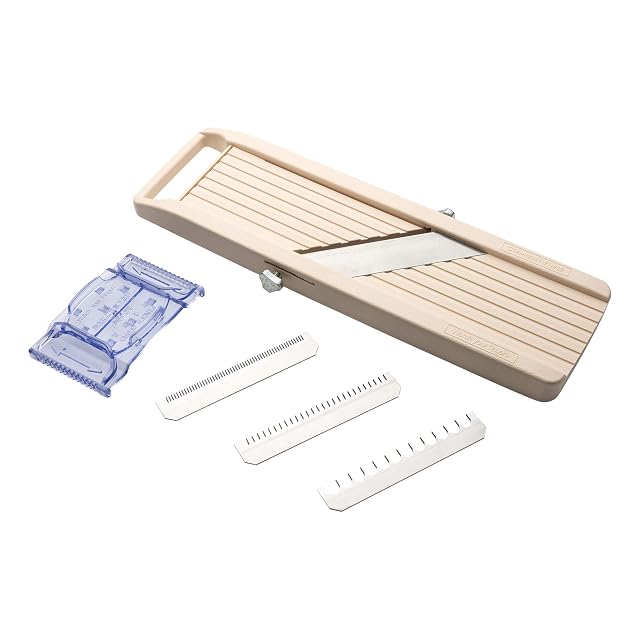
The one with the safest adjustment
The Benriner, 31.1 × 8.9 × 3.2 cm (12.2 × 3.5 × 1.3 in) with three interchangeable blades and a thickness set by screws on the body — away from the blade, rather than a lever beside it.
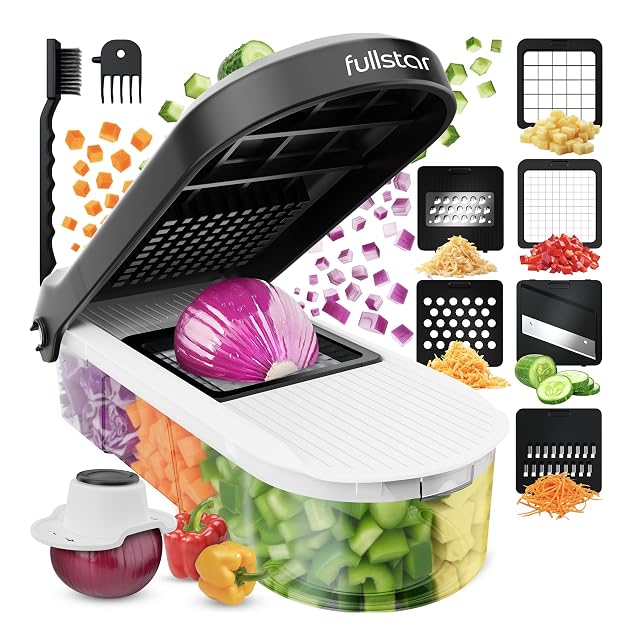
The one with the most blades
The Fullstar, six interchangeable blades in a hard ABS body with a collecting container: slicer, julienne and more.
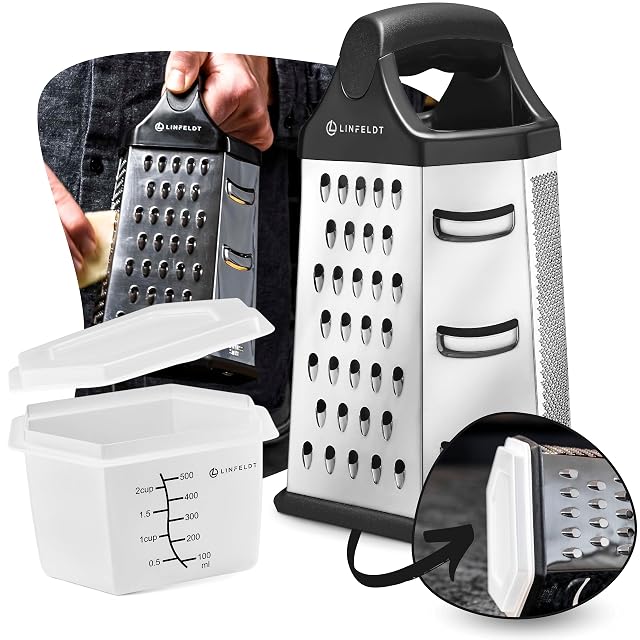
The graters
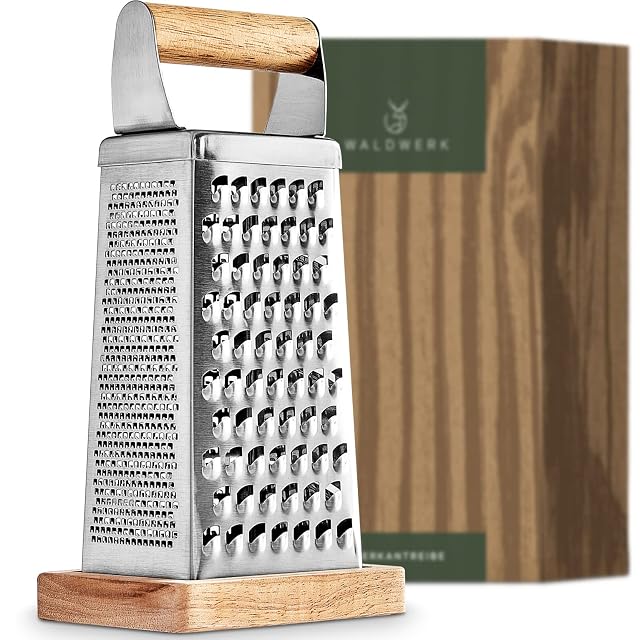
The Linfeldt 23 × 14 cm (9.1 × 5.5 in) with six grating faces, a silicone ring base and a container included. The Waldwerk 24.5 × 10.5 cm (9.6 × 4.1 in) with photo-etched cutting edges in 304 stainless and a real wood catching tray — etched teeth stay sharper than punched ones, and sharper teeth need less pressure, which is itself a safety property.
The last piece
Whatever the tool, stop before the end and put the last centimeter in a stock bag. It is a slice of potato against a stitch.
Which pan does your cooking want?
You use a mandoline
Use the guard, every time, with no exception.
You grate down to the last piece
That is exactly where the injuries happen.
You have children helping
Graters and mandolines are the tools to keep for yourself.
You cut yourself often
A cut-resistant glove costs little and solves it.
Picking by what you cook
Box graters
The everyday tool, and the one most often used carelessly at the end of a piece.
Mandolines
Extremely effective and responsible for a disproportionate share of kitchen injuries.
Rasp graters
Sharper than they look, and easy to catch a knuckle on.
Food processors
Where the safety question is the blade in the washing up, not the cutting.
What makes the difference in use
The guard
Every mandoline comes with one and it is the whole safety design. Using it is not optional.
Stability
A grater or mandoline that moves is a hazard. Both need a stable surface and a firm hold.
A cut-resistant glove
The single most effective addition, and it costs very little.
Sharpness
A blunt grater needs force, and force is what causes slips. Sharp tools are safer.
How you clean it
Reaching into a food processor bowl or scrubbing a grater by hand causes many cuts. Brushes exist for this.
Which figure for which dish
The tool
The main risk
The measure
Mandoline
The last slice
Always use the guard
Box grater
The end of the piece
Stop early or wear a glove
Rasp grater
Knuckles
Keep fingers behind
Food processor
Washing the blade
Handle by the hub, use a brush
Where it usually goes wrong
Not using the mandoline guard
It is the entire safety design of the tool, and skipping it accounts for most mandoline injuries.
Finishing the last piece by hand
The end of a carrot or a block of cheese is where fingers reach the blade. Stopping early wastes very little.
Working on an unstable surface
A grater that skids or a mandoline that shifts turns a controlled action into an uncontrolled one.
Reaching into a processor bowl
Blades sit hidden in soapy water. Handle them by the hub and never reach in blind.
By the cook you are
The mandoline user
Uses the guard every time and wears a cut-resistant glove for the last of a piece.
The everyday grater
Stops before the end and accepts a small piece of waste.
The household with children
Keeps these tools for adults and gives children other jobs.
Care, seasoning and how long it lasts
Blunt blades are the safety issue here, not just a performance one, because a blunt grater has to be forced. Graters also trap food in ways that make them unpleasant to clean by hand, which is how people end up scrubbing over a sharp surface.
Clean immediately, before food dries into the blades.
Use a brush rather than a cloth over any grating surface.
Replace mandoline blades when they stop cutting cleanly.
Store with blades covered or guarded.
Safety
These tools cause a disproportionate number of kitchen injuries.
Always use the mandoline’s guard, without exception.
Consider a cut-resistant glove; they are inexpensive and effective.
Stop before the last piece rather than pushing it through.
Never reach into a food processor bowl containing a blade.
Stainless V-blade · interchangeable inserts · folding foot · hand guard included
A stainless V-blade mandoline with inserts, a folding foot and — stated explicitly — a hand guard, which is the one thing the other mandolines here leave to the images.
Best for: Hard vegetables, where a V-blade earns its place.
24.5 × 10.5 cm (9.6 × 4.1 in) · PHOTO-ETCHED cutting edges · 304 stainless · real wood catching tray with non-slip feet
The only grater in this catalog that states its teeth are photo-etched rather than stamped — which is the specification that decides whether a grater cuts or tears.
Best for: Anyone who has been through two or three graters that went blunt.
Yes, from the first slice rather than the last. The accidents happen on the final centimeter of a vegetable, and by then the guard is across the room. The Silberthal here includes one; use it throughout.
Are cut-resistant gloves worth it?
For mandoline work, genuinely. This site lists gloves tested to EN 388, one of them at a published level E and one stated food safe. Cut resistance is not puncture resistance, but a mandoline cuts rather than stabs.
How do I set the thickness safely?
Before the food is in your hand, and with the blade away from you. The Benriner sets its thickness by screws on the body rather than by a lever near the blade.
Why are mandolines so dangerous?
They cut effortlessly, which means they cut fingers effortlessly too. Most injuries happen when the guard is not used on the last piece.
What about the last bit of cheese?
Stop early. The small amount you waste is nothing next to the injuries that happen at exactly that point.
Does sharpness matter for safety?
Considerably. A blunt grater needs force, and force is what turns a slip into a cut.
How should I clean a grater?
Immediately, with a brush rather than a cloth. Scrubbing a cloth over a sharp grating surface is how people cut themselves washing up.
Can children use a grater?
These are the tools to keep for adults. There are plenty of other kitchen jobs that suit helping hands better.
Lids, handles and spares from the same aisle, at the price we read. Confirm they match the pan you choose before ordering: it turns on the diameter and the part number, which the product page gives.
Boskermeal 8-Piece with Grater Attachments · Mixing bowls — An 8-piece set of five nesting stainless steel mixing bowls with three grater attachments for grating, slicing and shredding, plus lids, in thicker stainless steel with a mirrored interior, 100 per cent dishwasher safe · $22
COOK WITH COLOR 12-Piece with TPR Lids · Mixing bowls — A 12-piece set of six plastic nesting bowls with six TPR lids, in capacities of 0.32, 0.74, 1.37, 3.69 and 5.8 quarts, in BPA-free polypropylene, top-rack dishwasher, microwave and freezer safe · $27
The pans here are drawn from the catalog of this site. Specifications come from the maker and from the Amazon product page; prices are what Keepa recorded on the date below, and both move. Order is set by declared specifications, by stated strengths against stated limits, and by price. Nothing here has been cooked with by us, and no claim to the contrary is made.
Last checked on
Prices quoted in these summaries are dated readings. The live price is shown next to each product.
The tool we use ourselves
Chosen your tool? Now buy it at the right price.
Cookware sets, knife blocks and cast iron swing by thirty dollars or more across the year, and the biggest "discounts" often land at prices the same model sold for six weeks
earlier.
UniverTrack tracks the real price history across retailers, spots fake
reductions, and alerts you when it is genuinely the moment to buy.
Real price historyBuy-now alertsAI buying assistant