The romance of wok cooking is a roaring burner under a thin steel bowl. A domestic hob does not do that, and a wok that assumes it will disappoint. What works at home is a flat-based wok with enough mass to hold heat when cold food lands in it — and, on induction, a base that the hob can actually drive.
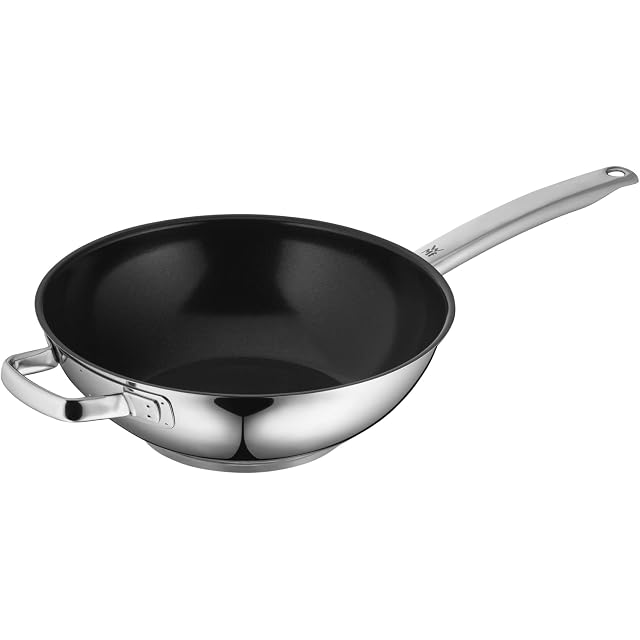
The WMF 28 cm (11 in), Cromargan 18/10 with a ceramic coating, stated to 400 °C (752 °F) in the pan, on a TransTherm base. A published temperature is what tells you the surface will survive the heat a stir-fry actually wants.
The one that tells you when it is hot
The Rowenta 28 cm (11 in), stainless body with a titanium-reinforced nonstick, Thermo-Signal and a riveted cast stainless handle. The Thermo-Signal marker changes at temperature — genuinely useful in a pan whose whole technique depends on being hot before the food lands.
The one with a lid
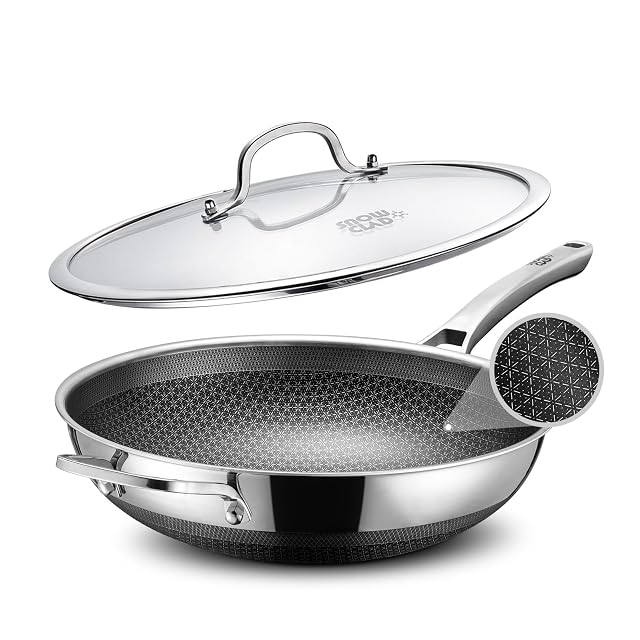
The Snowclad 32 cm (12.6 in), tri-ply stainless with a nonstick coating, lid included, oven safe to 250 °C (482 °F). A lid turns a wok into a braising pan, and 32 cm (12.6 in) gives room to toss.
The PFAS-free one
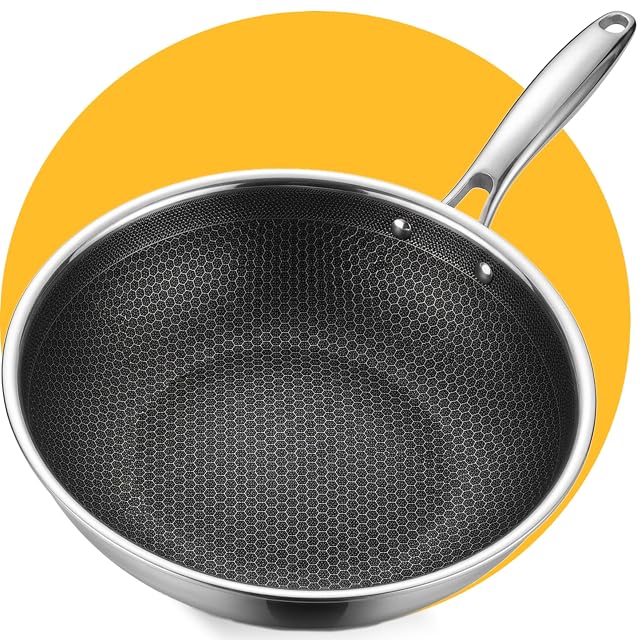
The Pasper 28 cm (11 in), stainless with a honeycomb-textured nonstick stated PFAS and PTFE free.
The one to check your hob for
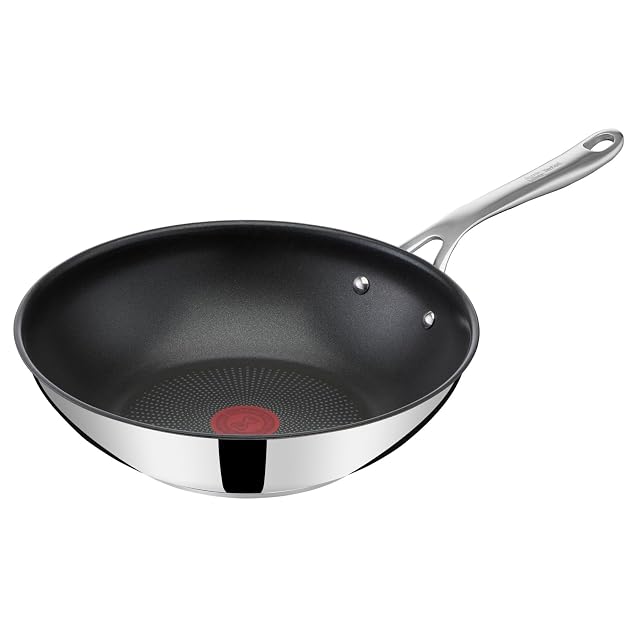
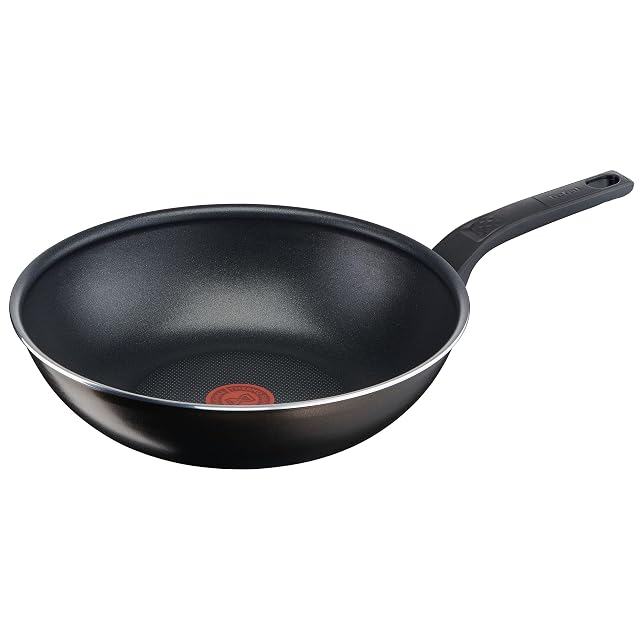
The Tefal 28 cm (11 in), titanium-reinforced nonstick with Thermo-Signal, made in France, and stated not induction compatible. On gas it is excellent. On induction it is a decoration.
The technique the pan cannot supply
Heat the wok before anything goes in, and cook in batches. A domestic hob cannot recover from a wok filled with cold vegetables, and that — not the pan — is why home stir-fries steam.
Which pan does your cooking want?
You have a gas hob
A round-bottomed wok with a ring is possible, and it is the traditional shape.
You have induction or ceramic
A flat-bottomed wok is the only workable choice.
You want real wok cooking
Accept that a domestic hob cannot match a restaurant burner.
You cook for two
A smaller wok gets hotter and works better than a huge one.
Picking by what you cook
Stir-frying
The main job, and the one most affected by domestic hob power.
Steaming
Where a wok with a rack and lid replaces a steamer entirely.
Deep frying
Where the sloped shape uses less oil than a straight-sided pan.
Everyday cooking
Where a carbon steel wok quietly becomes the most used pan in the kitchen.
What makes the difference in use
Flat or round base
Decided entirely by your hob. On anything but gas, flat is the only option that makes contact.
Material
Carbon steel heats fast and seasons well. Heavy cast iron holds heat but loses the responsiveness a wok needs.
Size against your burner
A wok wider than the flame only heats in the middle. Smaller often works better at home.
Weight and handle
Tossing is part of the technique. A wok too heavy to move is a wok used as a pan.
Realistic expectations
A domestic hob will not reproduce restaurant heat. Cooking in smaller batches is the workaround.
Which figure for which dish
Your hob
The wok
The technique
Gas
Round base with a ring
Closest to traditional
Induction
Flat base, magnetic
Contact is everything
Ceramic or electric
Flat base
Slower response
Any
Smaller wok
Cook in batches
Where it usually goes wrong
Buying a round-bottomed wok for induction
It cannot make contact and will not heat. Flat-bottomed woks exist precisely for domestic hobs.
Overloading it
Too much food at once drops the temperature and steams instead of frying. Batches are the domestic answer.
Buying too large
A wok wider than the burner heats only in the center. A smaller one gets properly hot.
Skipping the seasoning
A new carbon steel wok sticks badly. The first seasoning is part of buying one.
By the cook you are
The gas cook
Can use the traditional round shape with a ring, which is the closest to the real thing.
The induction cook
Needs a flat magnetic base and accepts the compromise.
The everyday user
Finds a carbon steel wok becomes the general-purpose pan for far more than stir-fries.
Care, seasoning and how long it lasts
A carbon steel wok improves for years and rusts in an afternoon. The seasoning builds with every use and is stripped by soap and scouring, while water left standing in the base does visible damage overnight.
Rinse hot, scrub with a brush rather than detergent, and dry over heat.
Wipe a thin film of oil on after drying.
Rebuild the seasoning if food begins to stick.
Avoid long acidic cooking, which strips the layer.
Safety
High heat and hot oil.
Never leave hot oil unattended.
Keep the wok stable; a round base without a ring can tip.
Handles get very hot on a wok; use a dry cloth.
Ventilate well, as wok cooking produces a great deal of smoke.
28 cm (11 in) · Cromargan 18/10 with ceramic coating · stated to 400 °C (752 °F) · TransTherm base · optimal for 22 cm (8.7 in) rings
A coated stainless wok on WMF’s TransTherm universal base, stated heat resistant to 400 °C (752 °F), and matched by the maker to a 22 cm (8.7 in) hob ring.
Best for: Induction kitchens that want a wok shape without seasoning a steel one.
28 cm (11 in) · stainless body · titanium-reinforced nonstick · Thermo-Signal · riveted cast stainless handle · induction
The top of this hub: a stainless-bodied wok with a titanium-reinforced nonstick interior, Thermo-Signal indicator, riveted cast stainless handle, and every hob type including induction.
Best for: An induction kitchen where the wok also goes to the table.
32 cm (12.6 in) · tri-ply stainless · nonstick coating · lid included · oven safe to 250 °C (482 °F) · dishwasher safe
The largest wok here at 32 cm (12.6 in), built as tri-ply stainless with a nonstick surface, supplied with a lid, and stated oven safe to 250 °C (482 °F).
Best for: A large household cooking one-pan meals, on a hob with a big ring.
28 cm (11 in) · titanium-reinforced nonstick · Thermo-Signal · made in France · NOT induction compatible
A coated 28 cm (11 in) wok with Tefal’s Thermo-Signal indicator, made in France — and, like its grill pan sibling, explicitly not suitable for induction.
Best for: Gas hobs, and anyone who wants a wok that needs no seasoning.
Flat, on any domestic hob. A round-bottomed wok needs a ring burner to sit in; on a flat hob it contacts in one small circle and heats nowhere else.
What size?
Twenty-eight centimeters is the practical domestic size. Thirty-two gives more room to toss and takes longer to heat on a hob that is already short of power.
Which one will not work on induction?
The Tefal 28 cm (11 in) states that it is not induction compatible. It is a good pan and it is made in France, and on an induction hob it will do nothing at all.
Flat or round bottom?
Your hob decides. Only gas can use a round base with a ring; induction and ceramic need a flat base to make contact.
What material?
Carbon steel is the standard: it heats fast, seasons well and stays light enough to move. Cast iron holds heat but loses responsiveness.
Can a home hob really stir-fry?
Not at restaurant heat, no. Cooking in smaller batches is the workaround, and it makes a much bigger difference than the wok itself.
What size should I buy?
Smaller than instinct suggests. A wok wider than your burner heats only in the middle, which defeats the shape.
Does it need seasoning?
A new carbon steel wok does, and it sticks badly until then. Seasoning is part of buying one rather than an optional extra.
Can I wash it with soap?
It strips the seasoning you are building. Rinse hot, brush, dry over heat and wipe with oil is the usual routine.
Lids, handles and spares from the same aisle, at the price we read. Confirm they match the pan you choose before ordering: it turns on the diameter and the part number, which the product page gives.
AOTHOD 446 °F Set · Silicone utensils — Food-grade silicone cooking utensil set rated to 446 °F with stainless steel reinforcement, a thickened soft silicone head for non-stick pans and a seamless one-piece design, dishwasher safe · $20
BESTZMWK 33-Piece 304 Stainless · Silicone utensils — 33-piece utensil set with thick top-grade 304 stainless steel handles and durable silicone heads, stated free of any plastic and of BPA, dishwasher safe with hanging holes · $40
The pans here are drawn from the catalog of this site. Specifications come from the maker and from the Amazon product page; prices are what Keepa recorded on the date below, and both move. Order is set by declared specifications, by stated strengths against stated limits, and by price. Nothing here has been cooked with by us, and no claim to the contrary is made.
Last checked on
Prices quoted in these summaries are dated readings. The live price is shown next to each product.
The tool we use ourselves
Chosen your tool? Now buy it at the right price.
Cookware sets, knife blocks and cast iron swing by thirty dollars or more across the year, and the biggest "discounts" often land at prices the same model sold for six weeks
earlier.
UniverTrack tracks the real price history across retailers, spots fake
reductions, and alerts you when it is genuinely the moment to buy.
Real price historyBuy-now alertsAI buying assistant